![neurotone-primary-logo-CMYK-1.jpg]](https://support.neurotone.com/hs-fs/hubfs/neurotone-primary-logo-CMYK-1.jpg?height=40&name=neurotone-primary-logo-CMYK-1.jpg)
Lace Pro is designed to benefit anyone interested in enhancing their listening and comprehension skills. We particularly recommend it for:
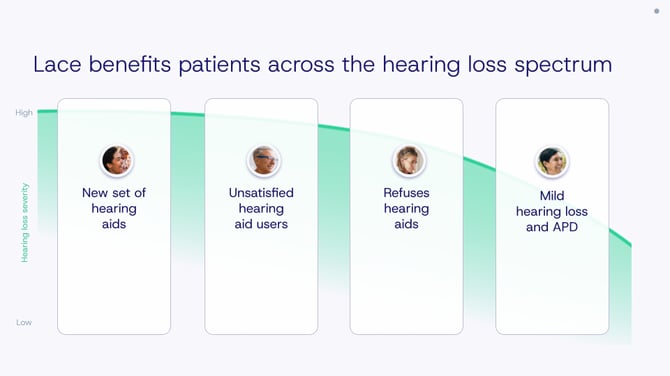
Patients getting a new set of hearing aids
When patients get new devices, it can take time for the brain to adjust to all the new sounds. Lace provides a safe, private space where patients can replay difficult sections, slow things down, and practice as much as they need — all without social pressure. Once patients practice in this guided setting, they feel more confident in conversations: at dinner, in meetings, or in noisy restaurants. Practicing with Lace translates into better focus and communication.
Unsatisfied hearing aid users
Even with well-fit devices, many patients continue to struggle in conversation. Even if they can hear, they can’t always understand. According to the longest-running, most comprehensive tracking survey of the hearing-impaired population and hearing aid market in the United States, about 18% of hearing aid users from in-person fittings are dissatisfied with their hearing aids. Many people eventually stop wearing their devices all together. For patients already using hearing aids, Lace is instrumental in achieving up to a 5-6 dB improvement in SNR within just 20 days. Such dramatic results underscore Lace’s role in significantly boosting hearing performance, particularly for those with severe hearing loss.
Patients who refuse hearing aids
Lace can be particularly valuable for patients hesitant to use hearing devices. It offers them a way to proactively engage with and manage their hearing health through a structured, 15-minute-a-day program. The typical outcome is not only improved auditory skills but also a greater openness to adopting hearing aids if needed, aided by the objective data from their QuickSIN scores.
Mild Hearing Loss and APD
Lace has demonstrated improvements in speech-to-noise ratios (SNR) by approximately 1-3 dB for those with near-normal to mild hearing loss. This change correlates with a 6-8% improvement in sentence recognition accuracy, as outlined by seminal research from Crandell (1991) and Wilson et al. (2007). Such enhancements are not just statistically significant—they're life-changing in their ability to enhance daily communication!